May 4th, 2009

CCTV consultation: Letter to the councillors

The following letter objecting to the nature of the CCTV consultation was signed by 22 Forest Fields residents and sent on Friday 1st May to the Berridge Ward councillors Hassan Ahmed, Mohammed Ibrahim and Carole-Ann Jones, and to Nottingham City Council leader Jon Collins. We look forward to their response, and will post an update as soon as we hear back from them.

To: Berridge Ward Councillors & Council Leader
The Council House
Old Market Square
Nottingham NG1 2DT

1st May 2009

Regarding: Proposed CCTV scheme in Forest Fields

Dear Councillors Ahmed, Ibrahim, Jones and Collins,

We are residents of Forest Fields who are very concerned about the proposals to install a CCTV system in our neighbourhood. We are aware that a public consultation is taking place to establish the views of people in the area. However, we are unsatisfied with the way in which the consultation has taken place.

On the consultation documents which were posted through our doors, there was no information whatsoever about the costs of the scheme. Neither was there any information about the effectiveness of CCTV in other areas, or statistics to demonstrate how it’s presence here might make any difference to crime and other problems in the area. Additionally, no information was given about possible alternatives to CCTV, such as better street lighting, investment in youth provision, improved traffic calming, more litter bins or more frequent street cleaning.

CCTV has been presented as the only available option for dealing with problems in Forest Fields, using statements such as “in order to help tackle crime and anti-social behaviour” and “combating anti-social behaviour and improving community safety”, without any suggestion as to how CCTV will do these things, or any factual basis offered for making these statements. There is an assumption implied that the presence of CCTV will help address issues in the area, yet several Home Office reports and numerous other studies have found that CCTV has a negligible impact on either prevention or detection of crime in residential areas.

At the public meeting on 23rd April, those present were able to find out about the costs of the scheme because members of the audience asked questions to elicit this information. However, the presentation by the police contained only anecdotal evidence about the effectiveness of CCTV (including references to CCTV in car parks), but yet again failed to provide any evidence or make any factual case for why CCTV is apparently necessary in Forest Fields.

We believe that when asking people to make a decision on whether or not they wish to have CCTV installed in their community, it is very important to present enough relevant information and facts to enable the public to make an informed decision. Nobody (whether voting for or against CCTV) has been given enough information to make an informed decision, and therefore the results of the consultation must be taken in this context.

A lot of other questions and concerns were raised by residents at the meeting, and with the exception of straightforward questions relating directly to quantifiable attributes the scheme (such as cost, number of staff involved, length of time footage is held etc.) few were answered in any depth, or to a suitable level of satisfaction. There has been no wider public debate around the issue, and it is not sufficient merely to note residents concerns without giving comprehensive answers and reassurance that the concerns are being addressed.

We believe that the case for CCTV in Forest Fields has not been made, and that consulting residents in this manner – without the necessary information, and without space for wider debate – can only give a distorted, undemocratic outcome. We believe that this is not the best course of action for our area, and that there are numerous other possibilities which ought to be explored and exhausted before resorting to intrusive, external (non-community based), reactive enforcement measures like CCTV.

Here are a selection of some of the concerns which we do not feel have been addressed. This is not an exhaustive list, but covers many of the main points:

  • The entire consultation process including the public meeting has not been based on facts or evidence to support the case for CCTV here, but on anecdotes and assumptions which are not supported by any studies – including those from the Home Office. Information given has been partial, and heavily biased in favour of CCTV, with no mention of concerns or alternatives.
  • All information in the consultation has been given exclusively in English, which is inappropriate when considering the ethnic diversity of the neighbourhood. Given that the City Council is now subject to a new statutory duty to “involve representatives of local people in the exercise of its functions”, we do not feel that the consultation meets this duty to the local community.
  • What assurance does the council provide, that the use of the proposed CCTV by police, the city council and other public bodies will be proportionate and proper? We would like assurance that the city council has robust operating procedures and mechanisms which guard against the misuse of the Regulation of Investigatory Powers Act 2000 (RIPA) in the surveillance of residents – please describe these in full.
  • In 2007 members of the London Assembly obtained information under the Freedom of Information Act that showed CCTV has little effect on solving crime. The statistics show that more CCTV cameras does not lead to a better crime clear-up rate. London has over 10,000 state run cameras.
  • Displacement of problems to other areas has been a consistent criticism of CCTV schemes, and the same will happen in Forest Fields. Problems will not go away, but will just move onto adjacent streets, out of range of the cameras. This is especially likely to happen due to the grid layout here, where there are many parallel streets which offer alternative routes to anybody determined to avoid being on CCTV.
  • A Home Office study in 2002 found that improved street lighting is up to seven times more effective at reducing crime levels in problem areas than CCTV, and this result correlates (albeit to a smaller degree) with another study carried out in the USA around the same time.
  • According to the Nottinghamshire Police “Crime Map”, Forest Fields crime rates have fallen 19.2% since the same three month period last year, and are “average” compared to the rest of Nottingham. Far from being a crime black-spot, our neighbourhood is generally quite a safe place with a strong sense of community, and any approach to crime reduction should be proportional.
  • In 2008, a Nottingham City Council report found that CCTV cameras in Nottingham do not reduce residents’ fear of crime. From our own enquiries, we have found that the opposite is true with some residents – that CCTV actually increases the fear of crime, because it’s presence indicates an area in which trouble is more likely to occur.
  • It is not sufficient to install CCTV here simply because the police or a group of residents are calling for it, or because it is an approach endorsed by the Council. If CCTV is to be installed here, there should be a factual basis for the decision, including supporting evidence.
  • Given that the basis for calling for CCTV in the area originally appears to have come from residents concerned mostly about fly-tipping, litter, speeding cars and anti-social behaviour on the street, there are a variety of other options which would deal with these problems far more effectively than CCTV. Many of these have no negative effects for the community, and no civil liberties implications.
  • CCTV is a “technical quick-fix” solution which does nothing to address any underlying social causes of problems in an area. Investment in strengthening the local community (particularly in youth provision, public spaces and events, and street cleaning) would be a much better alternative, and – given the poor track record of CCTV – probably more likely to reduce problems over time.
  • We feel that CCTV is not just a bad use of money, but that it’s presence actively disempowers a community from addressing problems in it’s midst. This is because CCTV places responsibility for the problem onto a faceless, external authority, which completely goes against the idea that a community can successfully resolve it’s own problems using non-litigative approaches.

In order that residents can make a clear and informed judgement, the council has a duty to provide a full and balanced case for and against CCTV, including such issues as value for money and effectiveness. This information should be presented to residents in written form, in a variety of languages in line with local demographics, before going any further with the process.

We would welcome the opportunity to come and talk to you about our concerns, and invite you all to meet with us for further discussion. Please let us know if this will be possible.

Yours sincerely,

(22 residents of Forest Fields)

April 29th, 2009

Report back from the public meeting, and comments on the sham consultation

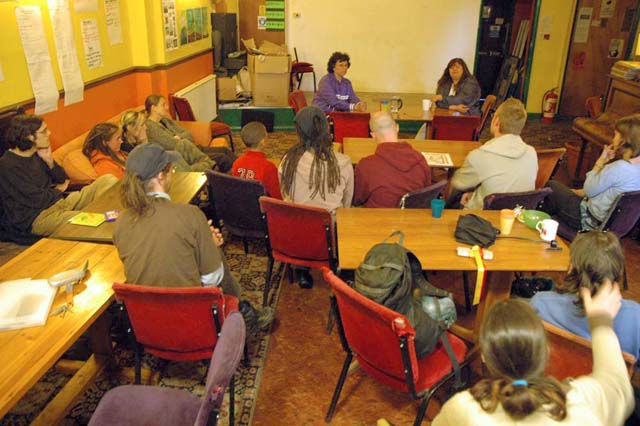
Around 60 people came to the public meeting on April 23rd about CCTV proposals for Forest Fields, which was organised by the Area 4 Neighbourhood Management Team, police and local council.

We also managed to get an article in the Evening Post to counter the previous completely one-sided pro-CCTV Evening Post article.

As one of the people who opposes the scheme, based on my experience at a previous public meeting (in which I was yelled at by three different people for daring to question the supposed “benefits” of CCTV for Forest Fields) I had been expecting a pretty difficult meeting, in which those who oppose would be in the minority.

I’m glad to say I was pleasantly surprised! People who opposed the CCTV scheme in Forest Fields made up at least two-thirds of those present at the meeting (based on a show of hands), and many had come armed with some tough questions, expecting answers.

Unfortunately, save for a few bits of vital information which should have been on the council’s door-to-door consultation leaflet, we didn’t really get much in the way of answers.

What we did find out:

  • The cost of installing the masts is around £3,000 per mast – thus £9,000 for the three masts proposed for Forest Fields.
  • Footage is held for 31 days.
  • The maintenance of Nottingham’s CCTV network is outsourced privately at the cost of £250,000 each year.
  • The CCTV scheme is intended to combat anti-social behaviour, reduce crime, and improve public safety and confidence. (Unfortunately, they still didn’t tell us how it will actually do this, but they assured us repeatedly that it will!)

The meeting was only an hour and a half long, and with most of it taken up with the presentation, there was only half an hour or so allowed for questions – let alone any in-depth discussion or debate. Most non-straightforward questions went unanswered or dodged, and reasons the public might not want CCTV here were at best glossed over, and at worst just dismissed.

As expected, the entire presentation was completely one-sided in favour of CCTV, but with very little (maybe even zero?) in the way of facts or statistics to back up the constant assertion from Inspector Gurmit Kaur that “CCTV does prevent and deter crime”. Perhaps this is because the statistics – from the government, no less – uncomfortably reveal that CCTV has a negligible effect on either of these things? Nearly all of the reasons cited for installing CCTV here were anecdotal, and unsupported by facts.

There was absolutely no mention whatsoever of any alternatives to CCTV in the presentation, and neither was there any mention of civil liberties concerns or other personal (and equally valid) reasons for not wanting CCTV here.

When confronted by one member of the audience with the Home Office CCTV Study (Feb 2005), which contains figures showing that CCTV has a negligible impact on crime, Detective Inspector Rob Griffin said that he had not read the report and therefore couldn’t comment on it.

Clearly, it is a mistake to assume that the police are interested in evidence to back up their claims about the effectiveness of CCTV – especially when that evidence says the exact opposite of their own personal anecdotes.

When another member of the audience said that she didn’t like the idea of her teenage son being treated with suspicion simply because of his age and appearance, and that she didn’t want her children growing up surrounded by CCTV cameras, D.I. Griffin responded (and honestly, I kid you not): “Let me ask you this – what if someone were to come into Forest Fields and take your child?”

He didn’t back down when challenged on the ridiculous nature of this question either!

I found it incredibly telling that one member of the panel who was most keen to persuade us that we should have CCTV here, actually knew the least in terms of a factual basis to back up his claims (because the facts show the opposite), yet was only too happy to resort to fear-mongering rhetorical questions, presumably in order to halt that line of discussion.

I left the meeting with a bemused sense of wonder – at how they could have had literally months to prepare this presentation, in the full knowledge that there is substantial opposition in the area (and already knowing what some of our arguments against CCTV are), and yet still do such an appallingly bad job of it?

Luckily, you don’t have to take my word on how bad it was, because you can take a look at the slides and listen to the audio yourself on Indymedia. (Thanks Tash!)

Nobody in Forest Fields has been given enough information to make an informed decision on whether or not CCTV is a good thing for the area, and therefore the entire consultation must be viewed in this context. Despite it now being on it’s second round, it is still an entirely inadequate sham of a consultation, and I now believe this is deliberate.

From the language used in the consultation and the completely one-sided presentation, it is abundantly clear that we are not being asked to express our views so that the police and council can make a decision, but that this whole thing is an exercise in ticking a few “democratic” boxes, while we roll over and accept their foregone decision that CCTV will be coming to Forest Fields.

I know we can do better than that, and show that if we really do want to make a better Forest Fields for everyone, it has to be through a much more committed long-term process to make positive improvements in the local community, rather than wasting money on negative, externalised technical “solutions” such as CCTV to video our problems.

CCTV is a lot worse than just an intrusive waste of our money – because it actively disempowers the local community and goes against the idea that our community is our responsibility to improve, and ours alone.

We should make no mistake – the meeting may have gone relatively well for opponents of the CCTV scheme, but this is far from over yet.

I sincerely hope that we won’t let the police and the council ignore our concerns, fly in the face of all the available evidence discrediting CCTV, sham their way through a “consultation” and foist their CCTV system on us.

Let’s stand up for Forest Fields and make sure that doesn’t happen!

April 18th, 2009

Text of our door-to-door letter, and other questions that need asking

I thought it would be useful to have the letter up here for discussion, so that folks from Forest Fields can see what our main points are. There are some other reasons for opposing the CCTV scheme which didn’t make it as far as the letter due to space considerations and/or lack of information at the time we went to print – more on those below. For now, here is the text of the letter we are delivering this weekend:

Dear Neighbour,

You may have heard that the council are planning to install a CCTV system in Forest Fields. The proposals have gone through several revisions, and currently they intend to install three masts. The suggested locations are on the corners of Leslie Road and Berridge Road, Burford Road and Berridge Road, and Gladstone Street/Alberta Terrace and Foxhall Road.

The council will be posting their own information and consultation sheet through our doors soon. We are writing to you separately – as a group of Forest Fields residents concerned about these proposals – to stimulate informed debate on the subject, and to ask you to consider whether CCTV is really the best use of funds for our neighbourhood.

In an Evening Post article on Monday April 13th, it was reported that people in the area are hopeful that the CCTV cameras will cut down on litter, anti social behaviour and speeding cars, as well as being used to tackle more serious problems such as robberies.

It would be great to see improvements around Forest Fields – after all, who wouldn’t want to live in a safer, cleaner neighbourhood? However, there is a huge amount of evidence to show that CCTV has little to no effect on crime in residential areas. More often than not, it is just an exercise in throwing expensive technology at societal problems, to be seen to be “doing something”.

Technology doesn’t do anything to address the underlying social issues – the only thing that can fix those is a better community. Thus, if there is money available for Forest Fields, wouldn’t it be better used to strengthen the local community, rather than to remotely video our problems?

Here are a few points to consider:

  • In 2007, London Assembly members obtained information under the Freedom of Information Act that showed CCTV has little effect on solving crime. The statistics show that more CCTV does not lead to a better clear-up rate. London has over 10,000 state-run cameras.
  • A Home Office study in 2002 found that improved street lighting is up to seven times more effective at reducing trouble in problem areas than CCTV.
  • Hoping that CCTV will tackle things like litter and speeding cars is pretty optimistic! The police are not going to trawl through hours of video to catch people dropping crisp packets and bottles, or driving too fast.
  • Displacement of problems to other areas has been a consistent criticism of CCTV schemes, and the same will happen in Forest Fields. Problems will not go away, but will just move onto adjacent streets, out of range of the cameras.
  • We are not convinced that the council has made the case for why CCTV is needed here, or produced any evidence to demonstrate how CCTV will address the issues they claim it will.

A presentation about the CCTV cameras will be held from 6.30pm until 8pm on April 23rd at Djanogly City Academy on Gregory Boulevard. We hope you will attend, and voice your opinions.

For more information, further reading and discussion, please see www.forestfields.org.uk, or email us at no_cctv@forestfields.org.uk

Additional things to think about (these weren’t on our leaflet):

  • Despite asking the Area 4 Neighbourhood Management Team about this on several occasions, we have been unable to find out the budget for the CCTV scheme. Neither of the leaflets they have put through our doors have any information at all about how much it is going to cost to install, maintain and monitor the CCTV cameras. Especially during a time of recession, it would be nice to know that councils are spending our taxes wisely, for the benefit of the community. Instead, we’ve been asked to vote on whether or not we want CCTV in Forest Fields, without having enough information made available for people to be able to make an informed decision. The cost of the scheme should have been on the leaflets that came through our doors.
  • Who are the Area 4 Neighbourhood Management Team democratically accountable to? They aren’t an elected body, so there’s very little we can do if we aren’t happy with them.
  • How will the votes on CCTV be counted, and what proportion will be required for the scheme to go ahead or be turned down? A simple majority? Two-thirds? We have no idea, because nobody has been told.
  • Who is counting the votes, and who are they accountable to?
  • CCTV won’t stop speeding cars. As with regular speed cameras, some drivers may slow down near the camera, but will speed up again when out of it’s range. Better traffic calming measures would be far more effective, and have no ongoing running costs attached.
  • Forest Fields crime levels and statistics from Nottinghamshire Police – speak for themselves! The crime level in this area is apparently “average” compared to other areas of Nottingham, and down by 19.2% from the same three month period last year.
  • In the Evening Post article about the CCTV proposals, PC Mark Tindall is quoted as saying “I personally think this is one of the best things to happen in Forest Fields.”
    For a vibrant area with quite a lot of small-but-interesting things going on all the time within the community – many of them incredibly positive for the local area – doesn’t it seems rather odd to ignore all that, and say that the arrival of CCTV is one of the “best” things to happen around here?
  • Many shopkeepers in the area seem to be largely in favour of the scheme – including those quoted in the article. Are the interests of shopkeepers the same as the interests of residents? Why were no residents (who aren’t also shopkeepers) asked about their views?
  • Does the Evening Post’s strap-line of “Forest Fields residents welcome CCTV move” – ahead of the residents consultation – not seem a little premature, or just a little bit of a sweeping generalisation? (If it’s already known that we welcome it, then why bother to ask us to vote on it?)

All these questions and more need to be asked at the meeting, or in writing, to:

Freepost RSBB-TUEE-XKXJ
Area 4 Neighbourhood Management Team
The Mary Potter Centre
Gregory Boulevard
NOTTINGHAM
NG7 5HY

In the meantime, if you’re after more information on reasons you might not want to welcome CCTV to our neighbourhood, the No CCTV website has plenty of in-depth material and facts to chew over.

April 17th, 2009

Anti-CCTV leaflet and poster

This weekend we will be doing a leaflet drop to the whole of Forest Fields.

For those interested in what the leaflet says, please see this PDF file.

Forest Fields CCTV letter (small)

Forest Fields CCTV letter

There is also an accompanying poster which has been put up in a few places locally.

CCTV Poster 3 (Small)

CCTV Poster 3 (Small)

A presentation about the CCTV cameras will be held from 6.30pm until 8pm on April 23rd at Djanogly City Academy on Gregory Boulevard. We hope you will attend, and voice your opinions.

See this post on Nottingham Indymedia for a few more updates.

Hopefully tomorrow, we’ll be adding more facts (with sources) to this website for discussion at the meeting.

February 8th, 2009

A Quick Introduction

What’s going on here, you might wonder?

Well, the website taking shape before your eyes is the eventual home of an as-yet unnamed group of people who live in the Forest Fields area of Nottingham, UK.

We love where we live, and want to make it even better. This website is the home of our project to do just that!

For now, while we work out what we’re aiming to achieve, other things we are working on are already happening – such as a campaign to keep CCTV out of Forest Fields. More on that soon – watch this space!